
Which New Hanover County Records Are Open
North Carolina law starts with a broad rule: a record made or received while an agency conducts public business is open unless another law protects it. In practice, access depends on the record set. A deed index is open, while a military discharge filed with the Register of Deeds is restricted. A court summary may be searchable even though a sealed case, juvenile matter, or adoption file is not.
| Local record set | Official keeper | Online route | Access level |
|---|---|---|---|
| Deeds, liens, plats, assumed names | Register of Deeds | Official records search | Free index and images, subject to redaction; office stations verify completeness |
| Civil, criminal, divorce, estate | Clerk of Superior Court | NC eCourts Portal | Public case data unless sealed or confidential; official copies from clerk |
| Ownership, assessment, parcel | Tax Administration and Land Records | iasWorld and NHC GIS | Free profiles and maps; web data can lag the official record |
| Birth, death, marriage | Register of Deeds and NC Vital Records | Certificate order channels | Certified copies limited to eligible people |
| Custody and offender information | Sheriff, NC DAC, and NCSBI | Separate official lookups | Published fields only; protected and juvenile data excluded |
| County administration and 911 | County Communications or 911 Center | Open Public Records portal | Chapter 132 access, subject to statutory exemptions |
The county’s information-request routing page is useful because it says what does not belong in the general portal. Marriage, divorce, traffic, civil or criminal disputes, and property or tax data go to their specialist custodians. That routing rule prevents delay and points each request toward the authoritative file.
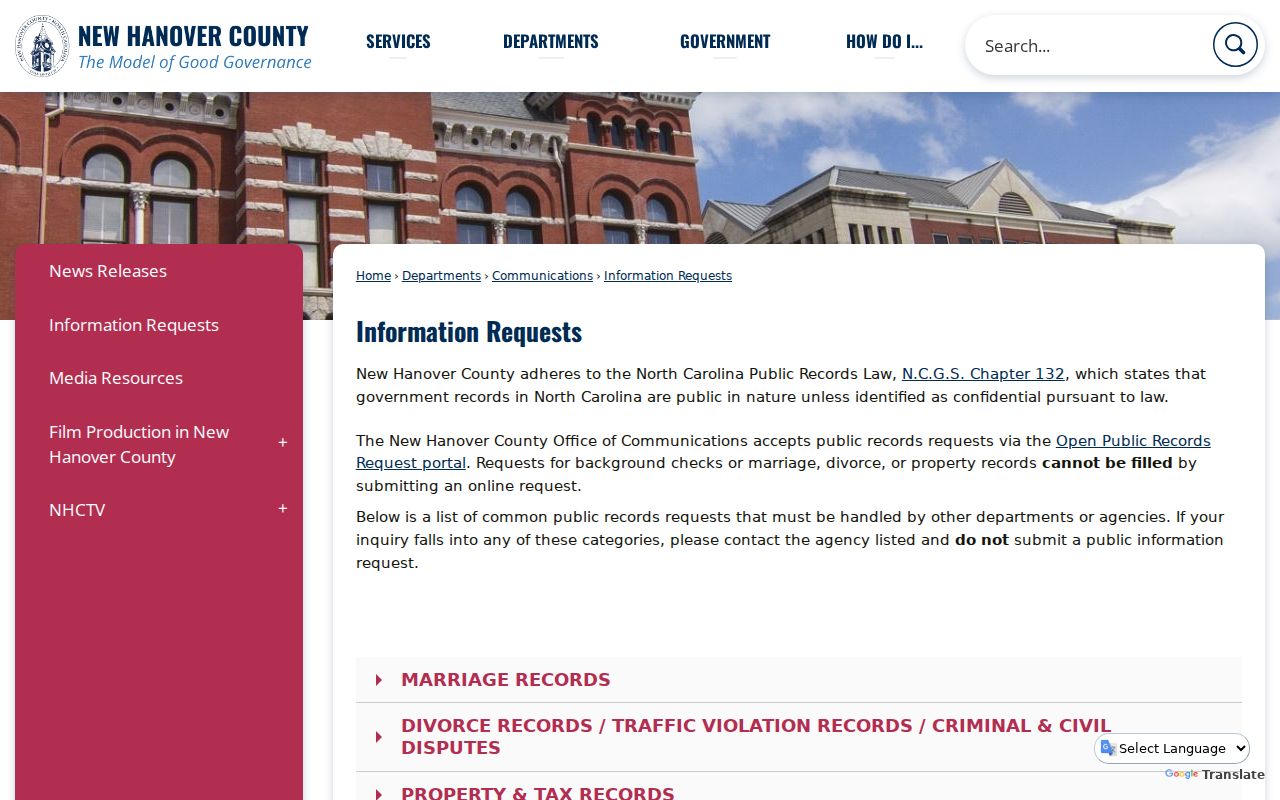
The captured county page shows why one broad request cannot replace the deed index, court clerk, vital-record desk, or property system. Start with the named keeper whenever the record category is known.
New Hanover County Deed Instruments
The New Hanover County Register of Deeds records land instruments, mortgages, liens, plats, assumed names, financing statements, marriage licenses, notary records, and county vital certificates. Estates and wills are not held there. Those files belong to the Clerk of Superior Court. The Register also keeps subdivision and condominium plats, but not each owner’s private survey.
Begin with the official Records Search landing page, then enter the dynamic vendor index. Search each plausible spelling of a grantor or grantee. A grantor transfers an interest, while a grantee receives it. Save the book and page or document number, then inspect the image. The county warns that web index data may be partial or may not show all recent updates.
When a web result seems incomplete, use a public search station at the Chestnut Street office or the Government Center satellite. The actual instrument and office computer are the Register’s completeness check. Indexing staff can also be reached at 910-798-7714. Historical county series at the State Archives and the Local History Room provide an offline path when an old transaction is not clear online.
Note: The research did not establish a reliable earliest online year, so no start date should be assumed for the deed portal.
New Hanover County Property Records
The Tax Department’s iasWorld system turns recorded deeds into a current ownership and assessment roll. Search modes include Owner, Address, Parcel ID, and Advanced. A property profile can show owner and mailing information, the physical property location, sales dates and prices, improvements, permits, land, values, exemptions, a sketch, legal-description data, and a parcel-map link. Ownership and characteristics may update weekly, while Land Records says its deed and GIS data can change daily.
Use New Hanover County GIS Online to add map and jurisdiction context to a parcel profile.
The map can help confirm an address, parcel, nearby streets, or permit context, but its lines are approximate. They are not a legal description. A deed and recorded plat govern the legal trail, and ownership does not prove that a named person lives at the site.
If the portal does not supply the needed data, submit the Tax Data Request form or contact Tax Administration at 910-798-7300. Counter service is at 230 Government Center Drive, Suite 190, Wilmington, on weekdays from 8 a.m. to 5 p.m.
New Hanover County Court Access
New Hanover County is served by Superior Court District 6 and District Court District 6. The Clerk at 316 Princess Street holds civil, criminal, traffic, divorce, estate, will, family, and special-proceeding files. For remote access, the statewide NC eCourts Portal offers an anonymous public search. All North Carolina counties completed conversion to the system in October 2025.
Smart Search accepts a case number or the name of a person or business. Filters help narrow broad results. A docket is the case’s dated list of filings and events; the portal may also show parties, hearings, case status, dispositions, judgments, and public documents.
| Portal field | Input | How it narrows a search |
|---|---|---|
| Smart Search | Case number, party, business, or nickname | Starts the case query |
| Location | Dropdown | Limits results to the relevant court |
| Party name and date of birth | Text and date | Separates people with similar names |
| Case type and status | Category and dropdown | Limits civil, estate, criminal, or other public matters |
| Filing date range | Date pair | Targets a known period |
| Hearing search | Name, attorney, judicial officer, or courtroom | Finds scheduled public events |
The web portal is the first tier, not the final one. Courthouse terminals can search civil files and can search criminal records by defendant, case number, victim, or witness name. Call the Clerk at 910-772-6600 for the authoritative file or a certified copy. Federal cases for New Hanover County use PACER through the Eastern District of North Carolina, not the state portal.
New Hanover County Vital Records
The Register of Deeds issues New Hanover County birth, death, and marriage certificates. Certified local copies cost $10, while uncertified copies cost $0.25. A certified copy requires valid identification and proof that the requester falls within an eligible relationship or legal role under N.C.G.S. §130A-93. The rule is not a simple schedule that opens all certificates after a set number of years.
The NC Vital Records order service covers statewide events and special cases, including adopted-person birth certificates.
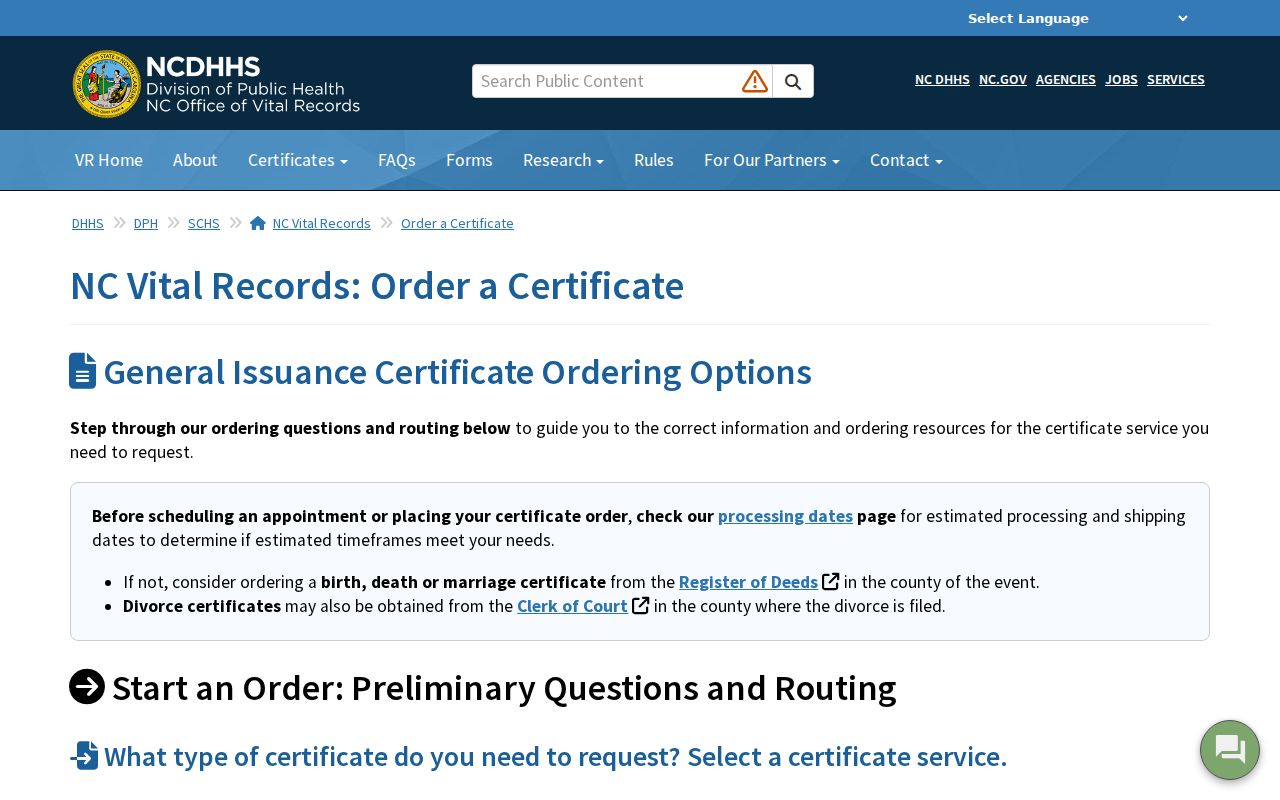
The state route offers mail applications and appointment-based service. Its base charge is $24 for a three-year search and the first certificate, plus $15 for an additional copy of the same certificate. County mail requests go to the Register at 320 Chestnut Street, Suite 120, with the signed form, proof documents, payment, and postage. The two Wilmington Register offices provide an in-person option.
Certificate limit. Public index facts and an uncertified abstract are not the same as a certified certificate. Protected birth, adoption, medical, and witness-protection data remain closed.
New Hanover County Public Records Custodians
A custodian is the office responsible for keeping and producing a record. New Hanover County divides that work among specialized desks. Calling the right one is often faster than sending a general form, especially for court, deed, tax, or certificate questions.
Clerk of Superior Court
316 Princess Street, Wilmington, NC 28401
910-772-6600
Tax Administration
230 Government Center Drive, Suite 190, Wilmington, NC 28403
910-798-7300
Law-enforcement sources are also split. The Sheriff detention page covers county custody, the NC Department of Adult Correction covers state custody, and the NCSBI registry has its own name and map searches. Incident and 911 material may require a records-unit or Chapter 132 request, while active investigations and protected victim or juvenile data can be withheld.
New Hanover Records Terms Defined
Official systems use a few terms that affect what a search result can prove. The distinctions matter when an online hit must support an estate inquiry, family-history project, ownership check, or civic review.
- Index
- A list that points to a filed record. It may show names, dates, and an instrument number, but it does not replace the full image.
- Certified copy
- A copy the custodian authenticates as a true office record, usually for a set fee.
- Custodian
- The agency or official that holds the record and decides access under the governing law.
- Exemption
- A law that protects all or part of a record from disclosure.
- Situs address
- The physical property location, which can differ from the owner’s mailing address.
An index can be a strong lead, but the image or clerk’s file carries more context. Compare names, dates, parcel IDs, case numbers, and book-page references before deciding that two entries concern the same person.
Request New Hanover County Public Records
N.C.G.S. §§132-1 and 132-6 permit any person to inspect an open record at reasonable times and obtain copies as promptly as possible. A requester does not have to live in North Carolina. The law sets no fixed response deadline, and it does not require an agency to create a new record or compile data it does not already keep.
- Identify the custodian. Do not send court, marriage, divorce, traffic, or tax requests through the county’s general portal.
- Check the office index first. Save a parcel ID, book and page, document number, case number, names, and a date range.
- Describe the existing record with enough detail to find it. State the preferred electronic or paper format and use the office’s portal, form, mail, email, or counter channel.
- Ask for a cost estimate when the request may require extensive staff or computer work. Narrow an overbroad request if that will reduce time and cost.
- If access is denied, ask for the legal basis in writing. N.C.G.S. §132-9 provides for enforcement in Superior Court.
Lawful use. Open access supports civic review and lawful personal research. North Carolina law prohibits stalking and harassing communications, and a public file is never permission to threaten or harm someone.
Note: A focused request with a record number, date range, and named division is more useful than a broad demand for every file about a person.
Chapter 132 Access and Fees
N.C.G.S. §132-6.2 lets the requester choose a medium the agency can produce. Online viewing or download may satisfy access. An ordinary uncertified-copy charge cannot exceed the actual direct cost of reproduction. A reasonable special service charge is possible when a request requires extensive use of technology, clerical labor, or supervision, and a database request may need to be written.
Local fee schedules still vary by product. Register deed images are free online. Counter instrument copies cost $0.25 per page uncertified, while certification costs $5 for the first page and $2 for each added page. County vital certificates cost $10. Court-copy prices depend on the requested court product and should be confirmed with the Clerk.
If a fee seems unreasonable, North Carolina law provides a State CIO mediation route. When a custodian denies access, the reason must identify the legal basis and must be put in writing promptly if requested. These rules apply to existing records, not answers to questions or a custom report the office has never made.
New Hanover County Records Privacy
Open government does not erase personal privacy rules. Chapter 132 and other North Carolina laws protect Social Security numbers, sensitive security material, tax information, some criminal-investigation files, privileged material, and certain 911 or utility data. The federal Driver’s Privacy Protection Act also limits personal information from motor-vehicle records.
Recorded documents can remain public after a protected identifier is removed. The Register’s redaction form identifies a filing by book and page or book and document number, then lets an eligible requester identify an SSN, account number, license or ID number, passport number, PIN, password, or employer tax number. Requests may arrive by mail, fax, electronic transmission, or hand delivery. Posted processing is one business day.
North Carolina’s Address Confidentiality Program gives qualifying relocated victims a substitute address. An actual address held by an agency is generally nonpublic under Chapter 15C, although the program cannot replace an address that must appear in a recorded land instrument. Sealed cases, expunged matters, adoption records, and juvenile records remain outside ordinary access even if a related name appears in an index.
New Hanover County Deed Alerts
The county’s free Property Fraud Alert watches for documents indexed under a registered name. It is a notice tool, not proof that fraud occurred. A person with a common name may receive an alert for someone else’s filing, so the right next step is to inspect the instrument and contact the Register at 910-798-4530.
The Register of Deeds services page links the alert and the official copy channels.
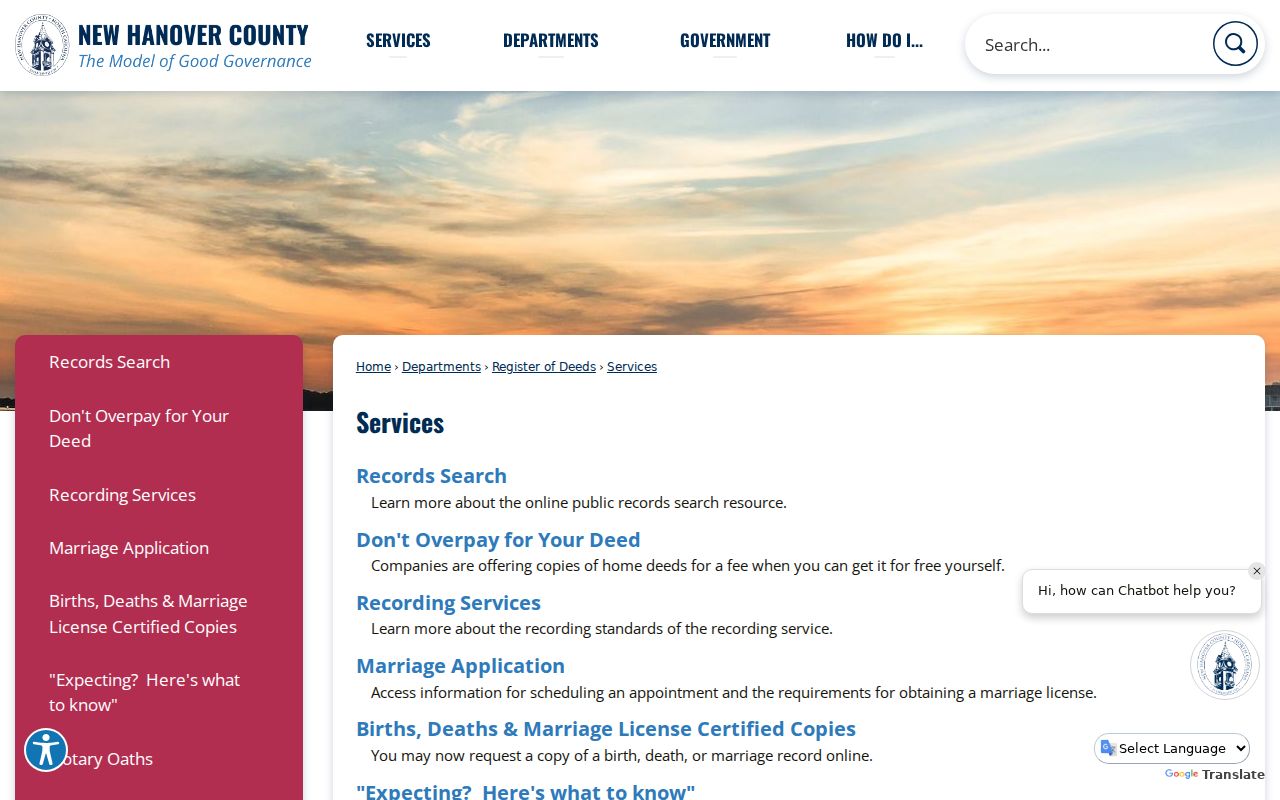
The county also warns against private letters offering an $86 deed copy. Official deed images are free online, and county counter rates are far lower. In fiscal year 2024-25, the Register added e-recording for maps and assumed names. A 2025 county assessment reported that 85 percent of Register records were digitized, which still does not mean every series is online.
Older New Hanover County Records Offline
When the modern portal stops, New Hanover County records continue through office stations, paper files, microfilm, and state archival series. The State Archives holds county records from the Clerk, Register of Deeds, Health, Planning, and other agencies. Its New Hanover miscellaneous collection spans 1756 through 1945 and includes appointments, bankruptcy papers, bills of sale, oyster-bed applications, hospital reports, pardons, and other name-bearing items.
The Local History Room adds directories, annual lists, yearbooks, maps, photographs, personal papers, town reports, and Lower Cape Fear publications. These sources can explain an older address or name variant before a deed-book or court-file request. For recorded land, use the historical name and address to locate the instrument, then ask the Register or Archives for the underlying image or volume.
Access channels work best as a chain: web index, office terminal, custodian copy, library collection, and State Archives catalog. That chain respects both the limits of digitization and the legal difference between a search aid and an official record.